
Hungary’s First Steps: Progress, Setbacks, and Challenges to Rebuilding Democracy. A 10-week scorecard. (Pt 1 of 2)
Peter Magyar and his Tisza party have moved quickly to beging cleaning house, prosecuting corruption, and advancing judicial reforms. But Orbán’s loyalists aren’t making it easy. (Part 1 of 2).

This article is one of a package of field reports from Hungary where I interviewed a range of activists, journalists, and sector experts in Budapest before the historic April 12 election that ending the hardline regime of far-right Viktor Orbán and Fidesz party. It’s also part of a comparative 10-country series, What Works to Stop a Dictator: Global Lessons for America. Check out the earlier Hungary stories and my reports Brazil and Argentina.
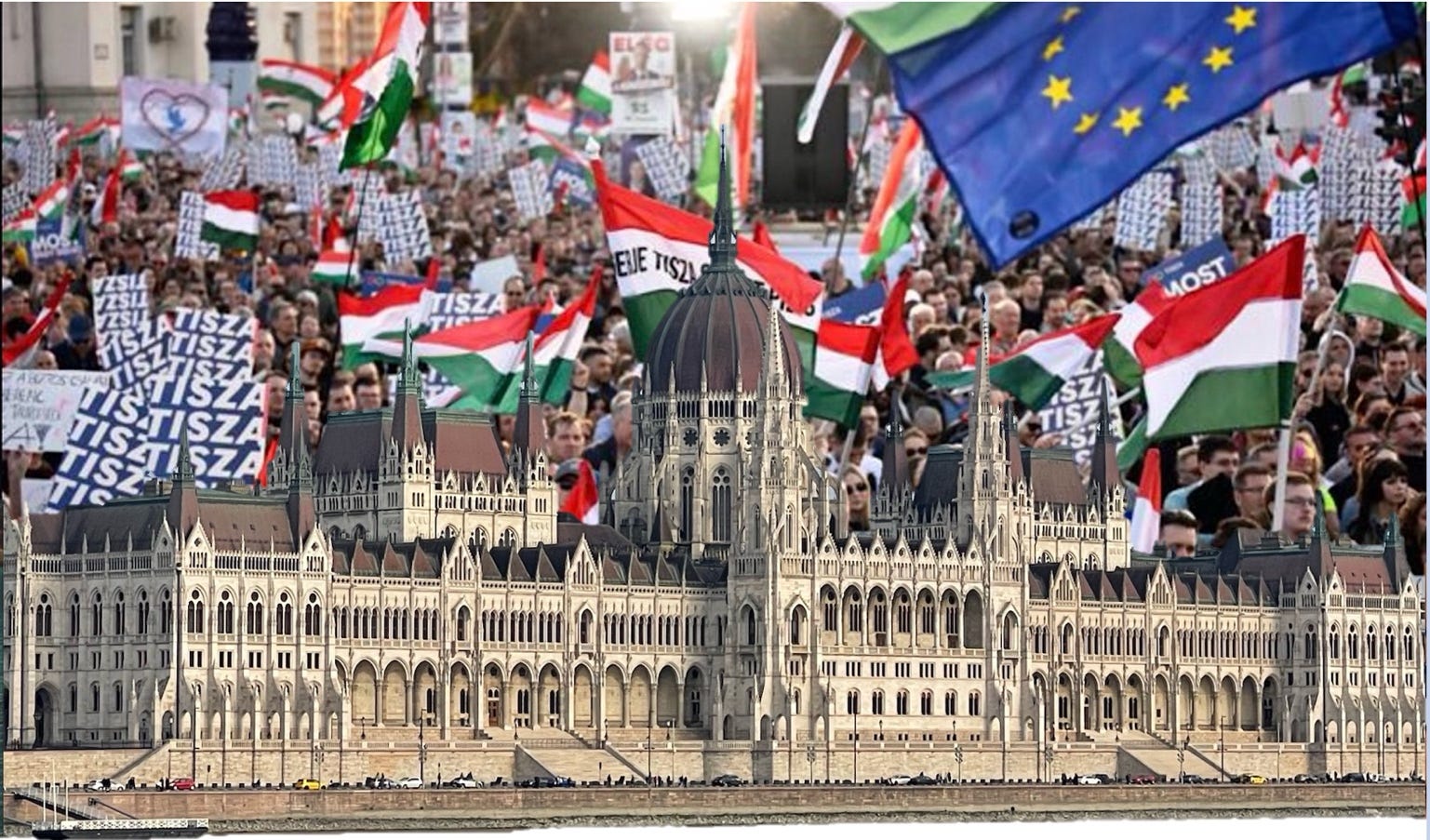
Hungary’s First Steps: Cleaning House, Rebuilding a Government — and getting ready to celebrate Pride again
On June 27, Hungary is set to host a party in Budapest that captures the ebullient mood it’s adopted since the landslide ouster of its longtime autocrat, Viktor Orbán, and the ruling far right Fidesz party, by opposition leader Peter Magyar and his center-right Tisza party. Tens of thousands of people from across the country and Europe, including EU leaders, are expected for a grand Pride party and parade that will mark a clear reversal of Orbán’s 2025 ban on Pride and his broader anti-LGBTQ+ agenda.
The new government also recently dropped Orbán’s legal cases against Pécs Pride organizer Géza Buzás-Hábel and Budapest Mayor Gergely Karáscony, who had defied the Pride ban in 2025. It also stated it will revise existing anti-LGBTQ+ Orbán legislation known as the Child Protection Act that outlawed LGBTQ+ content and criminalized transgender identity. That legislation served as the basis for the ban on Pride. That important promise followed a post-Hungary election ruling by the Court of Justice of the EU (CJEU) that Orbán’s Child Protection law violated EU norms and laws. The court decision put pressure on Magyar and Tisza to make good a campaign promise to uphold rule of law and adopt EU norms, which it has now started to do. The antigay law remains in place, and right now trans identity is still criminalized, but not for long, assuming the new government follows through.
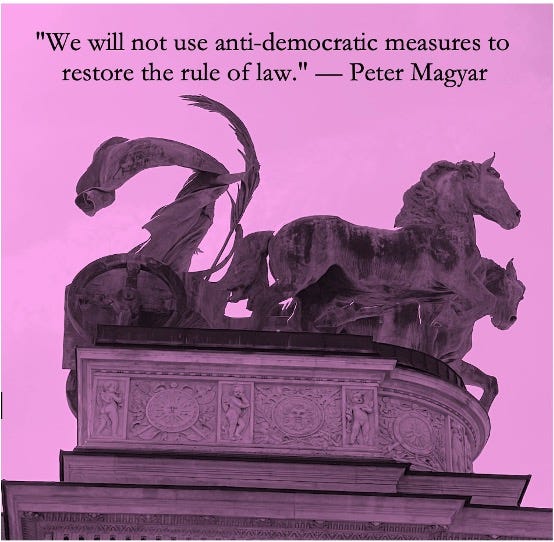
Photo: AC d’Adesky
Embarking on a broad agenda of reform
Magyar’s actions on LGBTQ+ rights are part of a broad menu of priority Tisza goals to reclaim a more democratic state and principles and revise Hungary’s Basic Law, or Constitution. The current Basic Law was put into place by Orbán in 2010 and repeatedly amended to tighten the noose on democratic freedoms and go after targeted groups including queer citizens and immigrants. Orbán did so with the direct support of Fidesz loyalists in the Congress and private sector oligarchs, many of whom were given plum positions in state agencies in exchange for financially backing Orbán. They also secured contracts that allowed them to plunder state entities.
Looking ahead, Magyar has made the review of Orbán’s contracts a key area of investigation and has moved, with limited success so far, to remove Orbán loyalists in key positions in state agencies and freeze the assets and bank accounts of billionaire cronies, including several Orbán family members who remain publicly accused of theft or corruption. Tisza has set up six “investigative committees” to look into corruption in different sectors, or tracks, but has provided little detail to date about their agendas, progress, or any deadlines.
Luckily, Tisza gained a super-majority in parliament; Fidesz has become a shadow of itself as a small minority party, with its influence in the EU also greatly diminished. That will allow Magyar to govern without too much opposition and implement reforms that a majority of Hungarians back, per polls. For his part, Orbán surprised some of his supporters by giving up his seat in the current Congress, but he remains active on the scene, hardly a shrinking violet after his drubbing. He’s set himself the task of rebuilding Hungary’s shattered far-right movement while staying put for now in Hungary, where he faces newly revived legal investigations into corruption.
As pundits see it, Orbán conceded his loss, but he keeps talking and acting as if he were still a boss. Call it denial; call it saving face. The bottom line is that he hasn’t gone away, nor sought refuge in America, as some predicted.
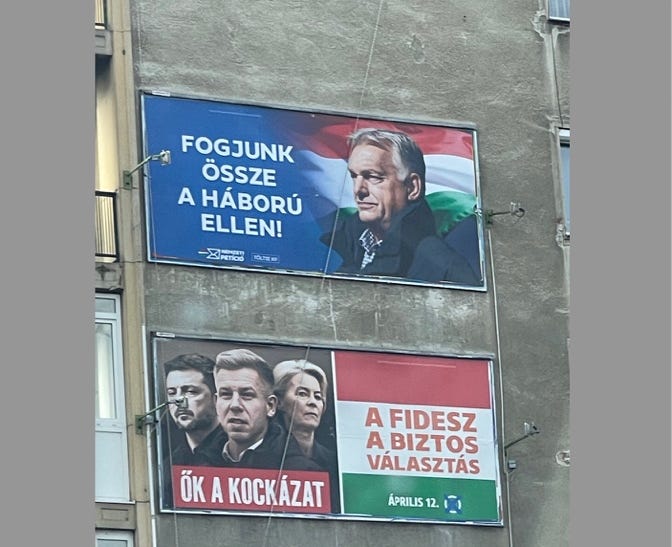
Orbán and Fidesz blanketed Hungary with campaign posters that promoted a strongman rule while demonizing Magyar and Tisza. Citizens didn’t buy it.
Photo: AC d’Adesky
Priority goals — and first setbacks
Overall, Magyar has thus made a strong start in his public statements and some early actions related to the key goals of his re-democratization agenda: rooting out corruption; prosecuting those who profited from it under Orbán; integrating Hungary further into the EU and playing a role there; revising laws and the Constitution to restore democratic principles; reforming Hungary’s weak, often hollowed-out institutions; and – importantly – building Hungary’s economy. That last part includes a plan to tax Hungary’s oligarchs, a campaign promise. It’s been almost ten weeks: he and Tisza have hit the ground running.
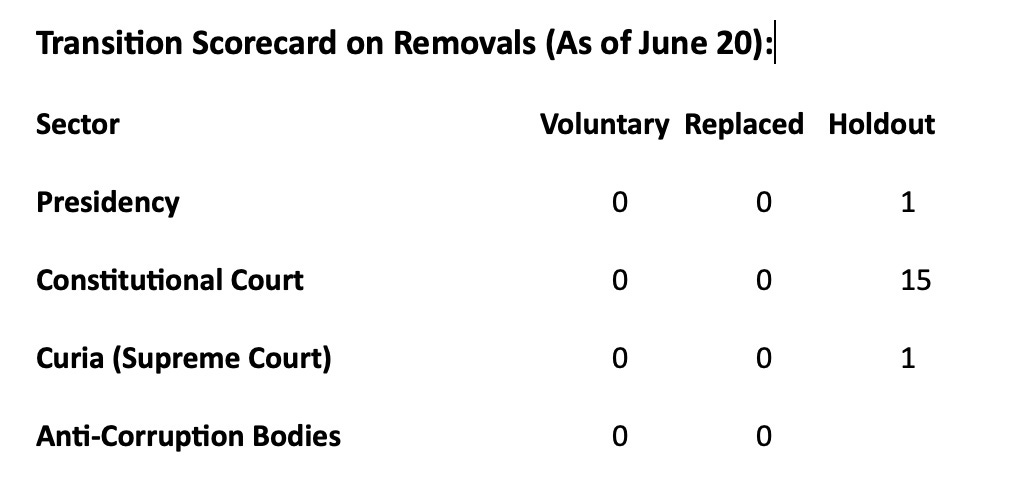
But he’s also encountered early hurdles in terms of implementation, and nowhere is this more visible than in the judiciary, which remains a key body to help or hinder the process and goals of legal reform. A stubborn group of Orbán loyalists, including Hungary’s current president, Tamás Sulyok, continue to refuse to voluntarily step down after Magyar called on them to do so, or be removed by a Congressional vote. Instead Sulyok just petitioned the Venice Commission, a constitutional review body, to assess the legality of Magyar’s demand that he step down or be removed. What that commission has no legal authority in Hungary, it has judicial credibility across Europe and the world. If it sides with Sulyok, it’s unclear if and how Magyar will move to oust the president, and that could extend to other stubborn loyalists. But Magyar has publicly promised Hungary, “We will not use anti-democratic measures to restore the rule of law.” So the new government must find a legal way forward.
A number of them also face public suspicions or accusations of corruption in cases that Magyar’s team will look into. So there’s a lot at stake for all parties – and for Hungary’s democracy. The fact remains that, after 16 years of Orbánism, powerful people who did the autocrat’s bidding are clinging to their seats, while Hungary’s richest families successfully moved a portion of their possibly ill-gained fortunes and assets abroad in the days after Magyar’s victory. How much of Hungary’s state money may have been transferred remains a topic of debate among intrepid journalists who continue to track the movements of the Orbán clan abroad.
Magyar and Tisza are also looking aggressively at the past and any current role Putin and Russia are playing in their national politics, elections, and EU matters, and support legal investigations into collusion with the Kremlin by Orbán officials (see intelligence scorecard below for more). Independent investigative media outlets including Direkt 36, Atlatszo, and VSquare have revealed how Russian spies, money, and capaigns helped Orbán spread misinformation via state media and social media outlets, and kept Putin officials in the loop about EU negotiations as they were taking place, on topics including Ukraine and NATO. So EU leaders are also looking at this.
To move forward, Tisza has to get rid of corrupt actors, but the process also has to be legal and transparent. It can’t be political score settling. For now, there’s a delay in the house-cleaning, even as Magyar vows to rally his Tisza majority in the Parliament.

Lawyer and ex-judge Adrienn Laczo (above right), and constitutional scholar Zoltan Fleck, a law school professor, were rare voices of judicial resistance to Orbánism.
Photos: AC d’Adesky
Emphasizing rule of law and transparency
A few weeks before the election, I interviewed two people while I was in Budapest who were playing a critical role as bold pioneers in advancing the demand for judicial reform and democracy in Hungary. Adrienn Laczó is a dynamic, outspoken lawyer who quit being an Orbán federal judge out of opposition to his regime and launched an NGO to fight for judicial reform – a rare judge to call out Orbán at the time. Zoltán Fleck is considered one of Hungary’s constitutional experts and teaches at the law school in Budapest. He was the sole member of a Constitutional Review body in late April; nobody else would join, too afraid of the repercussions of defying Orbán.
Both Laczó and Fleck did so, knowing their actions invited professional and personal risks, including a threat of personal safety to themselves and family members. Both were generous with their time with me, exploring what was at stake for Hungary’s democracy pre-election, and the legal and judicial steps that might follow a Magyar victory. Both worked to identify what Hungary might to reclaim its broken justice system, sharing ideas in scholarly articles, while studying what other countries did. They are now very busy, participating in multiple review and agenda-setting advisory bodies with an eye on priorities and timetables for revising Hungary’s Constitution.
Below, I discuss the first big steps taken by Magyar and Tisza to advance their democratic agenda, and I’ve included reflections by Laczó and Fleck on issues of removals, judicial reform, constitutional restraint, civil rights issues, and – importantly — needed civic engagement to assure citizens have a strong voice in shaping Hungary’s new Constitution. I’ve included removal scorecards that offer a snapshot of Hungary’s progress versus setbacks, arriving at the ten-week mark.
These steps reflect ethics, early policy statements, and actions of a skeleton government assuming power as agencies define new mandates and work to clean house down to the village level. New elected MPs and local representatives begin their terms with a public hungry for accountability. New oversight bodies are taking shape. The picture is likely to look quite different in a few months.
It’s also essential that Hungary embed democratic principles as it carries out its national makeover, in order to avoid any future would-be autocrats. As Laczó put it, post-election, backing Magyar’s committment to modeling democracy, “We need to have a new Constitution with all the checks and balances, and we have to make sure that the Constitution cannot be changed this easily anymore.”
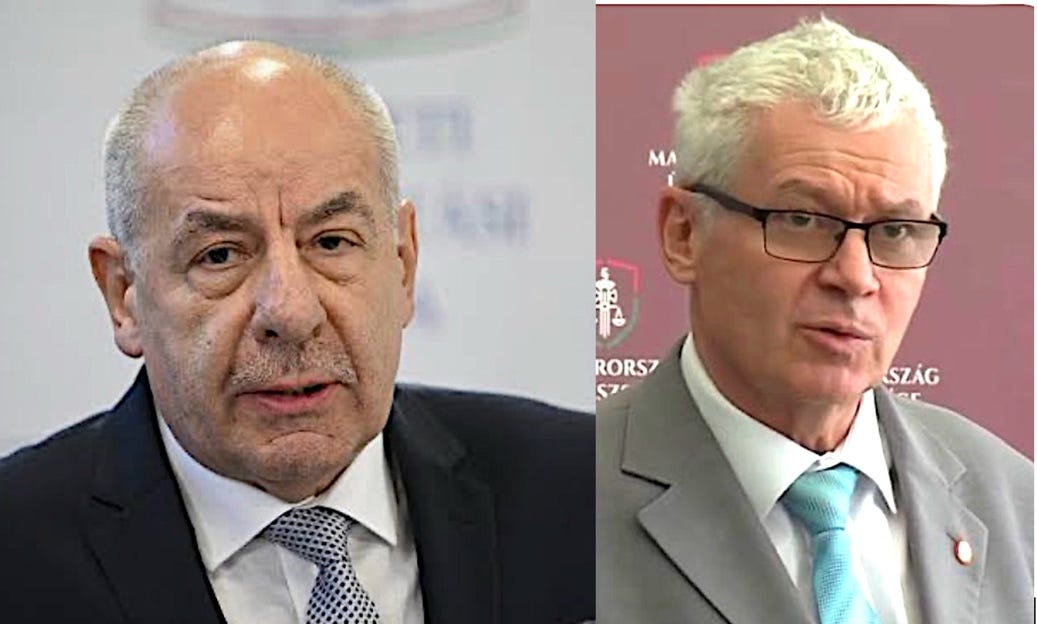
Clinging to power: Hungary’s current president, Tamás Sulyok (r), and Constitutional Court President Péter Polt (L), both seen as having allowed Orbán to consolidate his illiberal regime, have declined to voluntarily quit their posts. The battle is on.
A first big priority: removing corrupt judicial officials and restoring faith in justice
Over 16 years, Orbán made judicial capture a key ingredient of his iron grip on power. His early actions included removing judges deemed impartial or by-the-books and replacing them with far-right loyalists, including Christian conservatives. These include a roster of judicial officials who are in a position to impede progressive reform if they aren’t removed. Magyar is hoping to reform both the Constitutional Court, which is responsible for interpreting the constitution and reviewing legislation, and members of the Prosecutor’s office, which investigates and prosecutes corruption and criminal wrongdoing.
Shortly after his win, Magyar publicly called for the resignation of Constitutional Court President Péter Polt and 14 other court members, and gave them a May 31 deadline to leave voluntarily. When they didn’t, Magyar took another concrete step, announcing a plan on June 1 to amend Hungary’s Fundamental Law to remove them. He’s also seeking the resignation of the Public Prosecutor. In response, President Sulyok asked the Constitutional Court on June 11 for a formal opinion regarding Magyar’s plan, which punts the conflict to the Constitutional Court – where the loyalists remain.
Ah, the ironies … Orbánists seek Europe’s help to keep their jobs
Sulyok then added his request for the Venice Commission to weigh in like an impartial political referee and help decide if Magyar has the legal right to remove Constitutional Court officials with lengthy fixed terms. It’s a precedent-setting action, and has to be legal. The commission is made up of 46 Council of Europe member state judicial experts, plus other participating countries, for a 61-member review body. Hungary’s commission member is László Trócsányi, who was Orbán’s Justice Minister from 2014–2019 and then a Fidesz MP. That doesn’t mean he can’t be impartial, but critics are right to worry he’d protect Orbánists.
But, on a positive note, the Venice Commission repeatedly critiqued Orbán laws, and that included Hungary’s Sovereignty Protection Act. So it’s shown a penchant for rule-of-law decisions.
Until recently, the burning questions remained: if the commission says Magyar is going too far in calling for the removals, will he pivot or drop his demand? Or, two, if the commission says the law supports Magyar, will Sulyok and Bolt and other loyalists agree to step down? Or, three, will they then attempt to use other legal maneuvers to delay being removed from power as long as possible. It doesn’t take a genius to anticipate option three, regardless of what the commission says. Like Orbán, they appear intent on making it as hard as possible for Tisza to act upon its victory.
That includes the head of the Supreme Court, or Curia, Chief Justice András Zs. Varga. He was elected to a nine-year term in 2021 in a controversial appointment that defied the wishes of Hungary’s Natoinal Judicial Council, a self-governing body.
At the Public Prosecutor’s office, there’s a similar make-them-make-me-leave attitude on display. Until May 2025, Péter Polt was Hungary’s Chief Prosecutor. He resigned early, and was replaced by Gábor Bálint Nagy, who ably served Orbán and now says he intends to serve out his term, arguing that his position is professional, not political. (There haven’t been publicly reported resignations inside the prosecutor’s office to my knowledge, either).
But Magyar’s team is making a distinction between judicial officials and Orbán political appointees. While Sulyok’s petition gets reviewed, he’s wasted not time firing a number of top intelligence officials.
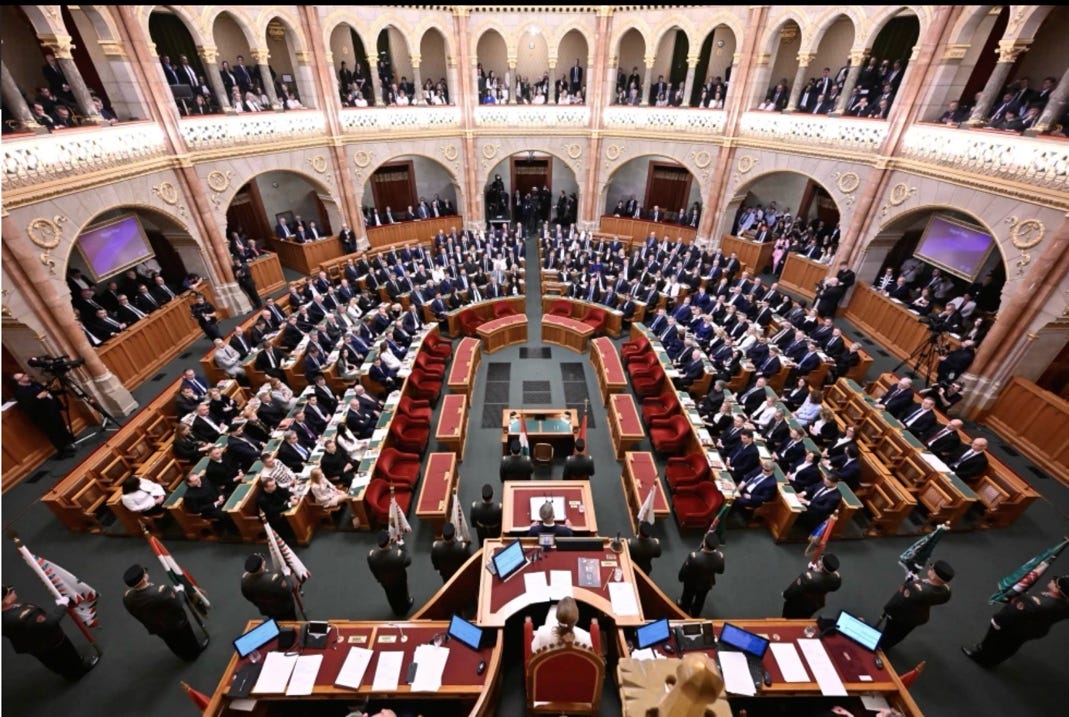
New leader Peter Magyar charts a new course at an inaugural Parliament session, May 9, 2026.
Photo: Denes Erdos | AP
June firings at spy and security agencies show Magyar’s commitment
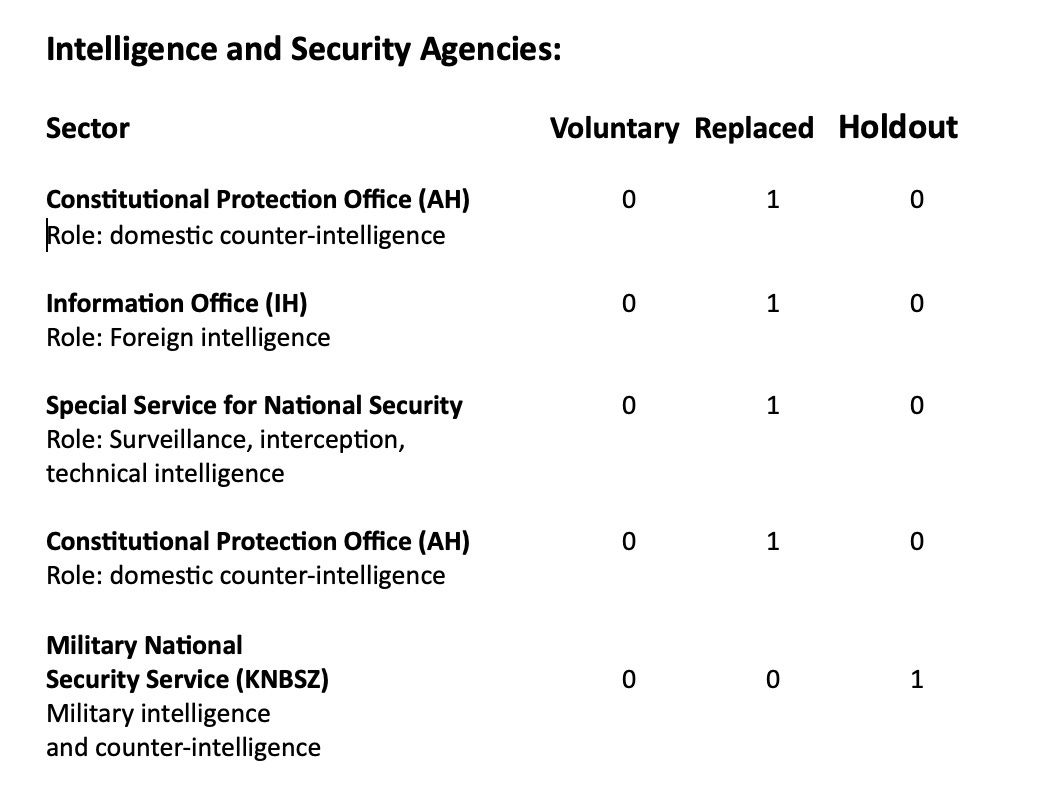
On June 13th, Magyar took decisive action to fire four Orbanist leaders at top intelligence and security agencies, cheering Hungarians who worried about a loss of momentum. Today, June 20, marks the last days in office for Szabolcs Bárdos, head of the Constitution Protection Office; Krisztián Oláh, head of the Intelligence Office (IO); Csaba Kiss, head of the Special Service for National Security; and Norbert Tajti, head of the Military National Security Service. The only major agency that remained untouched — for now —is the National Information Centre (NIK).
The government has not yet publicy announced their successors, and it’s assumed interim leaders are in place, while the agencies are restructured. Given media revelations of how Hungary’s intelligence and security agencies worked with Russia’s, one should expect new legal investigations could emerge once the rubble of housecleaning has cleared.
A national priority: rebuilding public trust
Laczó had this to say about the problem, pre-election: “The current public prosecutor’s office, headed by a politically appointed Chief Prosecutor, is one of the most striking examples of how corrupt power destroys its own institutions.” Looking ahead, she said, “I’d like to emphasize that to rebuild trust that has been completely lost, it is essential to ensure the independence of the work of prosecutors.”
Nor have officials who served under Orbán resigned from existing anti-corruption bodies like the Integrity Authority. There, Magyar’s team has moved to strengthen the agency, and give it a new focus, rather than purge its leadership. In some cases, he’s offering government officials a chance to prove that they can also adapt to democracy and rule of law, and make that their agenda.
It’s richly ironic, of course, that Orbán officials are now questioning Tisza’s right to revise the constitution, when that’s exactly what Orbán and Fidesz officials did to solidify their illiberal regime. Magyar argues that he has a clear popular mandate to fix an undemocratic constitution, and he does, but he still has to do it right. Can anyone really expect members of a Constitutional Court packed with loyalists to vote for their own removal? Or a partisan top prosecutor? No one in Hungary is holding their breath there. It’s going to take a tough political fight.
There are also alternatives that could overcome the problem of fixed term limits. Stated Laczó: “The solutions can be different according to the position. For example, for the Constitutional Court and the Curia, it is an easy way out to reorganize the structure and blend them into one big Supreme Court with the powers of both. This way the mandates of both presidents would cease to exist.”
Below is the yardstick on progress:
The setbacks …
and the notable progress …
End of Part 1.
Continued in Part 2.
To readers:
Will you help us share the progress notes in this post by restacking it and sharing a link in your social media and with your community networks? If you enjoy it, please help us get that word out. As longtime subscribers know, we keep this newsletter free to assure everyone can access the practical content related to strategy and lessons of effective resistance to confronting autocratic rulers and regimes that also focuses on what follows the ouster of a rogue leader. But we rely on readers to support our reporting, and thank paid subscribers in particular who help make the global field reporting of What Works to Stop a Dictator possible. A big, big thank you to those who have made this extra commitment.
I want to welcome new readers and invite anyone who can afford to do so to consider an upgrade to a paid subscription. I continue to offer a steep 58% discount on an annual subscription to this newsletter, including comparative global series. There are just three countries left complete field reporting before the mid-terms. Every bit of your help gets me there. Thank you.
Also, apologies for the delay in posting….
I want to add an apology for the recent brief pause in posting of the Hungary series articles; I had unexpected back-to-back trips. Now I’m pleased to lean back into the remaining Hungary package, and the coming reports from Serbia and Poland that also have positive lessons to share with us here in the US. I’ll be focusing on Germany and outside Europe to complete the field series, and plan a big picture wrap-up of the myriad take-home steps, too. Trying to share as much practical “what work” resistance lessons to benefit us here at home before the mid-terms.
Since I was just in France, Italy, and Austria, I’ll add that European eyes remain on the US, watching every move of our resistance to the Trump 2.0 attacks on our democracy. But there’s also a real momentum among European activists, NGO leaders, and journalists I spoke to regarding Europe’s willingness to step up and steer the global democracy ship. They view Trump 2.0 as a global threat to European and Middle East security and world peace, and view it as capitulating or in collusion with Putin, and wrongly allied with far-right despots. From Ukraine and NATO, to Iran and Cuba, to illegal foreign US strikes on civilians and ICE detention camps, to US funding cuts in public health and fresh worries about hantavirus, to the sprawling scope of the Epstein files, to Russia, China, and the Middle East … European progressives are deeply concerned and watching closely. But they’re also hoping their actions help us and encourage us to fight back. On the score, Hungary has certainly inspired us all and reignited faith in the project of democracy. — AC
This is a massive, important project. I hope it gets the traction if deserves. Posting to li.
Always great to read really smart well written journalism. Cleaning up deeply embedded corruption not easy. US has devolved quickly to blatant forms of governmental fraud and corruption. The big tell-all will be the November elections. Thanks again for the article.