
Surviving Orbán (con't.): An interview with Hungarian LGBTQ+ activist Géza Buzás-Hábel. (Pt. 3 in a series)
A Q & A with Hungary's Pécs Pride organizer, who's faced a now-suspended Orban regime criminal investigation and possible jail time for having defied a government ban on Pride.

Note: This story continues the 3rd article in my series of field reports from Hungary. See the first part here.
It’s also part of a larger series, What Works to Stop a Dictator: Global Lessons for America. You can read the introductory article on Hungary’s first post-election steps (parts A and B) here; a piece on the future of LGBTQ+ Hungary, and earlier reports from Brazil and Argentina for a comparative view of successful resistance strategies to stop autocracy.
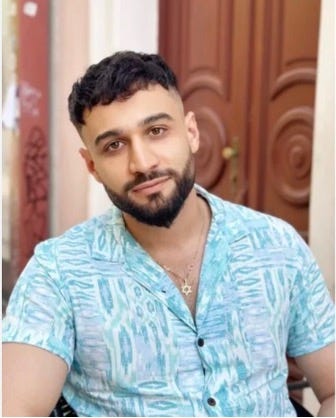
A teacher and Roma activist living in rural Pécs, near the border with Croatia, Géza Buzás-Hábel lost his job and found others were afraid to hire him when he refused to accept Orbán’s ban on Pride and criminalizaiton of LGBTQ+ identity.
Photo: Diverse Youth Network
A Q & A with Hungarian LGBTQ+ activist Géza Buzás-Hábel
Part B - story continued from part A.
ACD: I want to talk about legal case. A few questions ... on February 9, 2026, you were accused of violating the law and faced a possible one-year prison sentence after Orbán banned the organization of Pride events in Hungary. Were you surprised that the regime carried out its threat? How did this affect your sense of security? The safety of your family?
Did your loved ones support your decision to organize Pécs Pride? Also, what did it mean in concrete terms that you were “under active investigation”? Were you monitored by state agents or police when you left your home, the Diversity Youth Network office, or when you were in public spaces?
Finally, did you feel the threat that came with the criminal investigation differently compared to how things were for you before the case? Or did you feel more protected because the public was aware of the threat?
GB-H: For me, the political and media attention surrounding Pride did not really create a significant personal burden. In fact, I did not engage with it too deeply; I simply let events unfold as they did. This was not the issue that affected me the most. The truly difficult period began in December 2024, just before Christmas, when I lost all of my state-funded jobs. This was particularly painful for me because I truly loved teaching, and the Gandhi Gymnasium was an extremely important place in my life. I was very attached to the school, my colleagues, and my students.
Behind these events was the fact that the Constitution Protection Office — an intelligence agency — put pressure on the school’s leadership using methods that I would prefer not to discuss in detail at the moment. What I can say is that it was a particularly insidious method that many people have described as resembling a “Russian-style” approach. Because of this, I initiated a data protection lawsuit, and I would prefer to wait until the legal process is concluded before speaking about the details publicly.
The absurdity of the situation is illustrated by the fact that this authority primarily deals with counterterrorism and national security risks. To this day, I do not know which of those two categories I was supposed to fall into.
This period was extremely difficult for me. For nearly a year, practically no one dared to offer me a job. Even now I only have temporary employment: until December I am working as a social worker in homeless services, replacing a colleague who is currently on parental leave.
ACD: I understand that you lost your teaching position because of your open support for the LGBTQ+ and Roma communities. Did this case change your public position or reputation as a former teacher/educator? Did local educators support you?
How afraid were you during your recent legal ordeal? How did you mentally prepare for the possibility of going to prison? How do you feel emotionally now, beyond the sense of relief? Do you feel vindicated? Could you describe your current emotional state in terms of personal security?

Dorrottya Géczy is the Educational and Research Coordinator at Diverse Youth Network. The organization advocates a feminist, pro-diversity, intersectional approach to organizing and coalition-building among vulnerable minorities. The group has been a strong advocate for Roma rights in Hungary.
Photo: Diverse Youth Network
ACD: In terms of support, who helped you in this process, if anyone? What legal principles or arguments did your lawyers use that proved successful in this case? Did you actively participate in shaping these arguments? Please briefly summarize the strategy. The charges were dropped on February 28; did you expect this? Yes/no? Do you have any comments?
GB-H: My former colleagues at both of my workplaces have been extremely supportive. To this day they reach out to me, ask how I am doing, and many have openly expressed their solidarity. This has meant a great deal to me and continues to give me strength. My workplaces—especially in education—were not only professional environments for me but also strong human communities. The relationships formed there went beyond a simple employment relationship; they became genuine professional and personal alliances. For this reason, losing my positions was not only an existential loss, but also a deeply emotional one.
As for fear, interestingly I did not experience this period as constant terror. I have always believed in what I do and in the legitimacy of the cause I stand for — the defense of human rights and the dignity of Roma and LGBTQ+ communities. Because of this, I did not really imagine the worst-case scenarios in my mind. Of course, I was aware of the risks, but I tried to focus more on action and on my work rather than on fear.
Mentally, I prepared for the worst possibilities by thinking through my options. If the situation had escalated completely, one option would have been to leave Hungary. Many people would probably have left already when they lost their jobs and were effectively pushed out of the system. But I feel a very strong attachment to this country. I consider myself a patriotic person, and I have always believed that my role is to try to contribute here to creating the conditions for a better and more just Hungary.
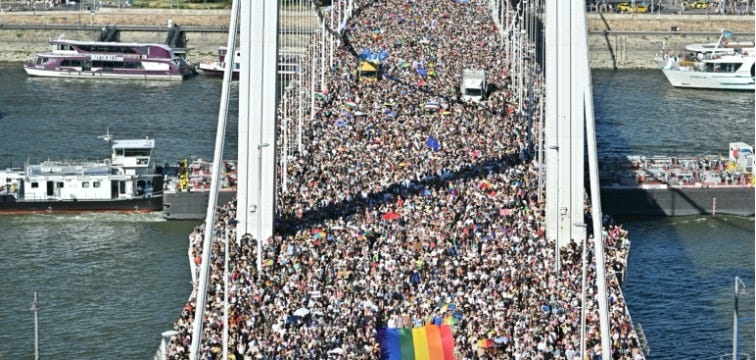
Hungary’s 2025 Pride march drew 200,000 participants and revealed broader public support for LGTBQ+ rights, many marching for the first time. Recent polls confirm that trend.
Photo: Atila Kisbenedek | AFP via Getty Images
Lessons for other LGBTQ+ activists
ACD: Are there any steps or lessons you would share with other activists facing similar threats elsewhere?
GB-H: For other activists who may face similar pressure, I would say that it is extremely important to have a community around you. Situations like this are very difficult to endure alone. The support of my colleagues, friends, and professional allies meant a lot to me.
Legal protection and awareness are also crucial: it is important to know your rights and to have professionals — lawyers and human rights defenders — whom you can trust and turn to.
Regarding the legal strategy, the main role was naturally played by my lawyer, Dr. Zsolt Szekeres. I relied on his expertise and professional experience, while trying to provide all the information and context that could help build the case.
One of the key elements of the defense was to make it clear that my activities constitute legitimate civil society and human rights work, closely connected to the fundamental values of a democratic rule-of-law system. When charges were brought against me on February 28, I was of course shocked by the decision. However, the legal process did not end there: we appealed the prosecutor’s decision, and yesterday the judge suspended the proceedings. This was clearly a relief for me, even if I cannot say it came entirely as a surprise.
Throughout the process I believed that, in the end, common sense and well-founded legal arguments would prevail. At the same time, cases like this are inherently unpredictable, so one can never be completely certain of the outcome.
The judge has now referred the case to the Constitutional Court because he found the legal provision underlying the indictment to be constitutionally problematic. This means that the procedure is not yet fully concluded, so the story is not over — but the current decision is definitely an important and reassuring turning point for me.
Emotionally, what I feel most strongly is relief, though the situation is more complex than that. There is also a kind of quiet sense of strength in realizing that it was worth persevering despite the difficulties. It is not so much a feeling of “victory” as the sense that I have managed to survive an extremely demanding period. The feeling of personal security does not return overnight, of course, but I now look toward the future with much more calm and hope.
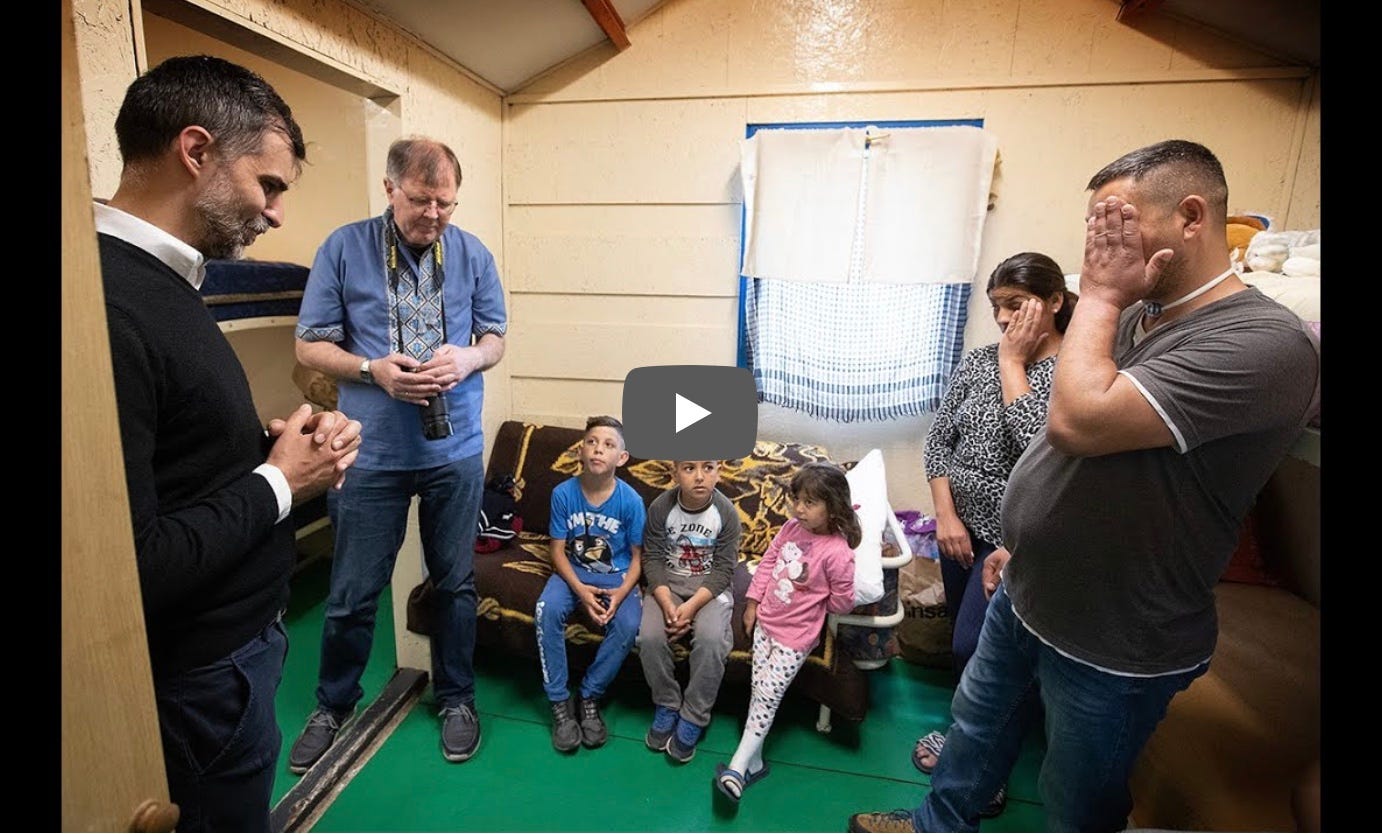
Diverse Youth Network is among local groups helping newly arrived Roma refugees fleeing the war in Ukraine. Above: United Methodist representatives provide support to vulnerable Roma refugee families who are among new asylees in Hungary.
Photo: United Methodist News
ACD: I want to talk how your case served to mobilize both pro- and anti-LGBTQ+ sentiment. In terms of homophobic opposition, to what extent did your legal case provide a new rallying point for anti-LGBTQ+ groups in Pécs, including the far-right and allies of Fidesz? What kinds of violent threats or backlash did you — or your youth organization — face after legal proceedings were initiated against you?
GB-H: I was not directly targeted by public attacks in government communication related to the case. There were some attempts on media platforms associated with the Mi Hazánk (My Homeland) movement, which often has a neo-Nazi character, but these were mostly general antisemitic, anti-Roma, and homophobic remarks that reached a relatively small audience. Of course, hate speech appeared on social media, particularly in the comment sections under articles, but personally I do not pay much attention to those.
The pressure appeared more indirectly. Our organization had previously faced situations where some of our members were called in by their employers and asked to explain their connection to our organization. In some cases, they were even asked to remove their names or photos from our website. Because of this, last year I took on most of the organization’s public communication myself. We did not want to risk anyone’s livelihood.
To be honest, I do not necessarily feel that this is my strongest role, and there were probably people who would have been more suitable for it. However, we were not in a financial position to compensate someone for taking on that responsibility; nor could we guarantee protection from potential consequences. In the end, that responsibility remained with me.
ACD: Your actions triggered new global solidarity (ILGA, All Out, Amnesty, Helsinki Committee in Hungary, etc.) and made you one of the recognizable faces of the Hungarian LGBTQ+ movement. What did it feel like to be in this spotlight? What opportunities has this opened — or could open — for you as a queer and Roma advocate?
GB-H: To be honest, I found the spotlight difficult to handle. Perhaps someone else would have been able to consciously build a personal image or political capital from it, but I was neither particularly capable of doing that nor did I really want to. For me, the high visibility actually meant more risks than opportunities. For example, I was without a job for almost a year, and I often felt that, because of my public profile, many places simply did not dare to employ me.
There is also a certain paradox when it comes to identity labels. I personally see myself primarily as a professional working on Roma issues. However, within the Roma movement many people tend to view me mainly as an LGBTQ+ activist, and for this reason I am sometimes less frequently invited into professional collaborations. At the same time, within the LGBTQ+ movement, I often appear as a Roma activist.
Honestly, I do not particularly like these labels. I have never liked defining myself according to what kind of “activist” I am. I believe much more in a universal human rights perspective and in the politics of solidarity. In Hungary, this approach is still relatively underdeveloped.
This is precisely why the work of the Diverse Youth Network is pioneering: we consciously focus on building solidarity between marginalized communities and minority groups, and we are among the few organizations that consistently apply an intersectional approach. We believe that solidarity between different minority communities is not only a moral question but also one of the key drivers of meaningful social change.
ACD: Let’s talk about the impact of your and your organization’s actions. You organized the largest Pécs Pride in history, with as many as 8,000 participants, which was a remarkable achievement despite the repression. Were you surprised by the level of participation?
GB-H: It did not surprise me that much, because after Budapest Pride it was already predictable that many people would also attend in Pécs.
ACD: As an LGBTQ+ leader, what negative impact has the case had on your work? On your youth organization? Conversely, what concrete positive outcomes has it produced? Has it shifted the priorities of LGBTQ+ advocacy in any direction?
GB-H: The personal consequences are unfortunately quite tangible. As a teacher, for example, it is currently almost certain that I will not be able to find a position in public education for some time. The effects are also visible at the level of our organization: the number of project partnerships has decreased, and several potential partners have informally indicated that they are concerned that cooperating with us could have negative consequences for them.
At the same time, the case has also had positive effects. It significantly increased our visibility and drew greater international attention to our work and to the situation of the LGBTQ+ community in Hungary. Our core priorities have not fundamentally changed, but the past period has reinforced our belief that visibility, community dialogue, and the building of social solidarity must remain key areas of focus.
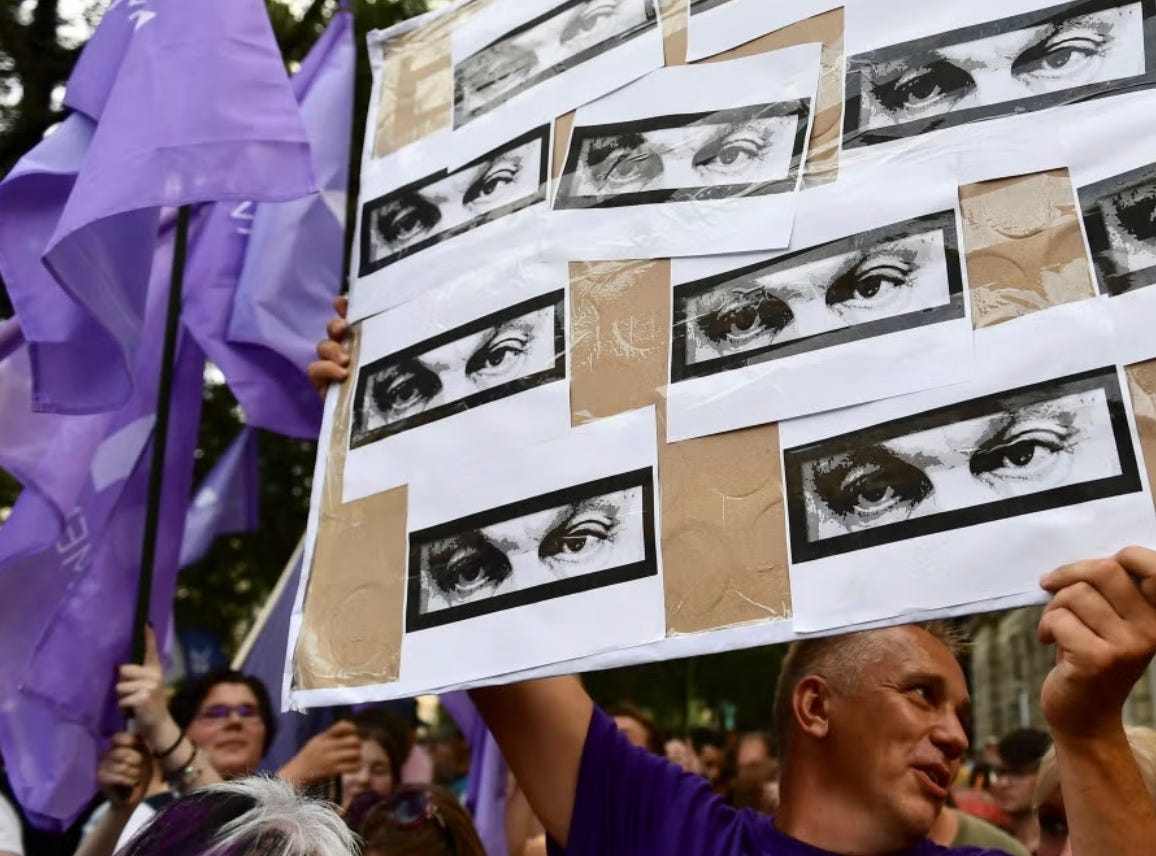
Orbán’s takeover of state media companies to create a national propaganda arm and legalizing of state surveillance to intimidate and crack down on LGBTQ+ critics and independent journalists drew global condemnation by human rights groups. Above: Hungarian protesters holdi signs with Orbán’s eyes.
Photo: Human Rights Watch
ACD: How would you evaluate the media coverage of your case in Hungarian state-aligned and independent media?
GB-H: Over the past five years, this was already the second time that we appeared very prominently in the media. The first such moment was in 2019, when we announced that we would organize the first Pécs Pride in 2020. Although the event was ultimately cancelled due to the COVID pandemic, the issue became a recurring topic in both local and national media for nearly a year after the announcement. In Pécs, the issue even appeared on the agenda in several schools: debate days were organized on LGBTQ+ rights, which showed that the topic had sparked a genuine social discussion.
However, in Hungary, a large part of the media landscape is dominated by pro-government outlets, while the independent press is relatively small. Because of this, at the time the vast majority of the coverage about us — around 90-95% — had a negative tone. Local pro-government politicians, for example, launched a signature campaign to pressure the city — which was already led by the opposition at the time — to prevent the Pride event from taking place. At that time, the current restrictions on the right of assembly did not yet exist, so legally the event could not have been easily banned.
To be honest, the period when we were preparing the first Pride was much more stressful. At that time even several local civil society organizations — which are generally considered progressive or pro-freedom — approached us with reservations and did not provide clear support.
In comparison, the media coverage of the current case was somewhat more favorable. Although negative narratives continued to appear in pro-government media, the smaller but important independent national and international was able to frame the issue in a more balanced — and in many cases more supportive — way.
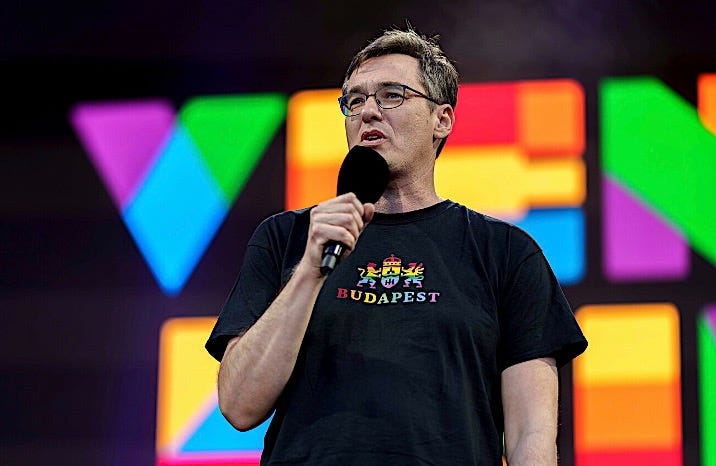
Budapest’s dynamic Mayor Gergely Karácsony refused to uphold Orbán’s Constitutional ban on Pride and outlawing of any LGBTQ+ content. Above, he speaks out against the Fidesz regime at Vienna Pride 2025, which became a solidarity event with Hungary’s LGBTQ+ movement.
Photo: Alamo
ACD: The mayor of Budapest, Gergely Karácsony, was threatened with imprisonment for supporting Budapest Pride. How closely did you work with his legal team or with city officials as the case unfolded?
GB-H: I did not have direct personal contact with Gergely Karácsony during the case. However, it is important to mention that we were both supported and represented by the same human rights organizations, so at that level there was a certain connection between the two cases.
ACD: Let’s talk about the impact of this on the Roma. You are an activist voice for Roma communities in Hungary and locally in Pécs. How would you characterize the Orbán government’s treatment of Roma people? How has your case affected — or not affected — Roma advocacy? Did you receive support from Roma leaders?
GB-H: It was important for me that several larger, independent Roma civil society organizations in Budapest publicly expressed their solidarity with me in relation to this case. This meant a lot, because it showed that within Roma civil society there is sensitivity toward human rights issues and a willingness to stand up for one another.
In Pécs, however, most Roma organizations operate in a strong dependency relationship because of state or municipal funding, which significantly limits their ability to speak out publicly. As a result, there was little visible organizational-level support. At the same time, several Roma public figures and members of organizations expressed their solidarity with me privately, on a personal level. From Roma members of parliament, however—even from the opposition side—there was no public gesture of support regarding the case.
Overall, the case perhaps highlighted the fact that Roma advocacy in Hungary often operates cautiously, and within a very limited space for action, especially when issues arise that are politically sensitive or potentially conflictual. In many ways, this reflects a broader structural problem: Roma communities in Hungary still lack strong and genuine political and cultural representation. This is partly because the community is often economically dependent, lacks a strong and stable middle class, and unfortunately personal career considerations can sometimes override broader community interests.
At the same time, it was encouraging to feel that several larger independent Roma civil society organizations in Budapest expressed their solidarity. In Pécs, although organizations themselves could not speak out publicly due to their dependence on government structures, individuals within those communities still expressed their support on a personal level. However, from Roma parliamentary politicians—even those on the opposition side—there were no public gestures of support.
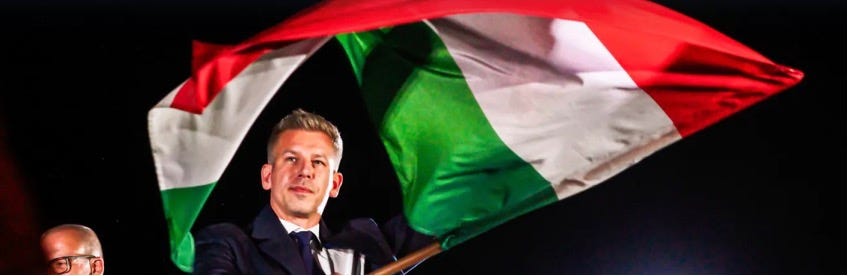
While Peter Magyar led Hungary to an opposition victory, ending Orban’s 16-year illiberal reign, LGTBQ+ activists say they’ll have to continue to exert pressure on the new Tisza government to not only decriminalize anti-LGBTQ laws, but advance their rights and demand for equality.
Photo: CEPA
ACD: What are your current advocacy priorities as a Roma activist?
GB-H: One of my most important goals is that, over time, a truly independent Roma political and cultural representation should emerge in Hungary. What is needed is a form of representation that does not appear in public life merely in a formal or symbolic way, but that has real influence and becomes an unavoidable actor within decision-making structures. It would be important for representatives of Roma communities to be genuine participants in political and social processes, rather than appearing only through symbolic or token representation. The community needs leaders who represent its interests autonomously, rather than acting as political puppets or party soldiers tied to particular political parties.
At the same time, I am aware that achieving this within the framework of majority political parties is extremely difficult. The self-organization of Roma communities in Hungary is still at a relatively early stage. In the longer term, it is conceivable that an independent Roma. political force could create this kind of autonomous representation. However, the current strong institutional and political dependencies often suppress such initiatives already at their early stages. Even well-intentioned allies sometimes struggle to step out of the ‘white savior’ role and truly create space for Roma communities to shape their own narratives and develop their own political power.
ACD: Regarding the coming elections and elections, I want to discuss future reforms. The Tisza Party has become a strong opposition movement. Some Hungarian LGBTQ+ activists I have spoken with in Budapest and in the diaspora feel that Péter Magyar is not sufficiently pro-LGBTQ+ as a leader—that he and his wife do not support same-sex marriage and have not supported Pride. According to this view, if he wins, Tisza may restore the rule of law and bring Hungary back to a pre-Orbán position, but may not significantly advance the civil rights of sexual minorities or possibly other minorities, such as Roma communities.
Do you agree with this assessment? How do you personally evaluate what might happen to the Hungarian LGBTQ+ movement if a: Orbán / Fidesz wins ... what could happen? Or b: Magyar / Tisza wins ... what could happen?
In your opinion, what should be the key priorities for political reform regarding the LGBTQ+ movement? Obviously, issues such as decriminalizing LGBTQ+ identity, protecting the right to organize, and removing restrictions on foreign NGOs operating in Hungary are central. What items would be on your “wish list”?
GB-H: A significant realignment is indeed taking place within the Hungarian opposition space, and the Péter Magyar–led Tisza Party has quickly become a strong political actor. At the same time, it is understandable that many LGBTQ+ activists are watching Magyar and the party’s position on these issues with some uncertainty. So far, a clear and explicit LGBTQ+ policy is not really visible either in the party’s program or in its political communication.
Magyar has stated in several interviews that he would restore the legal framework that existed before the rule of Viktor Orbán and his party Fidesz, and he has also emphasized that “love is free.” This is an important signal, but at this point it remains more of a general political message than a concrete policy agenda. It is also often argued that the party deliberately avoids emphasizing LGBTQ+ issues because this would provide easy targets for government propaganda.
Personally, I do not fully agree with this approach — especially after a Budapest Pride that attracted several hundred thousand participants. It is difficult to understand this level of caution. At the same time, the current political reality is that, for many people, the Tisza Party still appears to be a more realistic alternative than Fidesz.
If Fidesz remains in power, it would probably be the worst-case scenario for the LGBTQ+ community. Over the past years it has become clear that stigmatizing and politicizing LGBTQ+ issues has become part of the government’s political strategy. Another Fidesz victory would likely mean the continuation — or even the radicalization — of this policy. This would not only affect Hungarian domestic politics but could also have consequences at the European level, particularly at a time when right-wing and sovereigntist forces are strengthening across the European Union.
If the Tisza Party were to form a government, it would likely bring a kind of normalization: restoring rule-of-law institutions and reestablishing the legal framework that existed before Fidesz. In itself, this would already represent a significant change. However, at the moment it does not appear that this would necessarily include a progressive shift in minority policy.
For the LGBTQ+ movement, political priorities are currently relatively “low-threshold.” The most important goal is to restore the fundamental legal and democratic frameworks that existed before 2010: freedom of assembly, the free functioning of civil society organizations, the repeal of stigmatizing legislation, and the end of political campaigns targeting the community. Only after these conditions are restored can further expansion of rights realistically be discussed.
ACD: What about the same question regarding Roma communities in Hungary? What reforms would be most urgent there?
GB-H: Similar questions arise for Roma communities. One positive development is that Péter Magyar previously promised to place Roma candidates in electable positions on the party list, and he has now fulfilled this promise: five Roma candidates were placed in such positions. Among them is one of my closest friends, Krisztián Kőszegi. This is certainly an important step for Roma political representation.
The real question, however, will be how autonomously these representatives will be able to operate within the party. How much room will they have to represent the interests of their communities—or even express critical views within the party structure? This is something we cannot yet see; only practice will show.
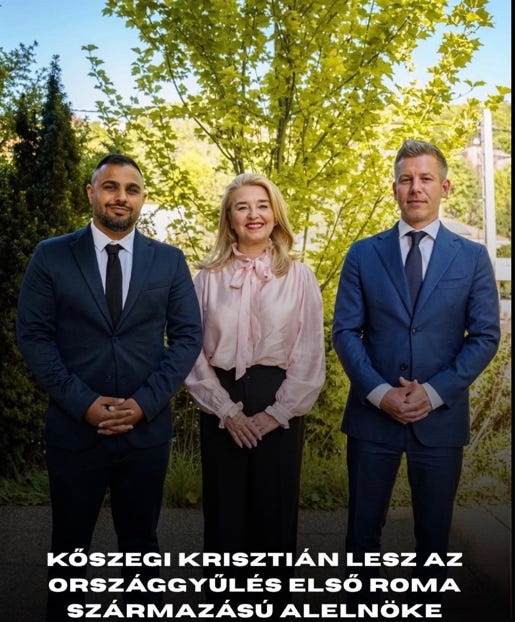
Diverse Youth Network celebrated the Tisza Party nomination of Roma leader Krisztián Kőszegi (top, left) for one of the positions of Vice President of the National Assembly. Since his election victory, Peter Magyar (top right) has nominated a total of five Roma parliamentarians — a historic record.
Photo: Diverse Youth Network
ACD: And the EU ... if Magyar wins, some hope that Hungary may return to a more liberal alignment with EU policies. This could mean greater rights for LGBTQ+ Hungarians. What is your view on this?
GB-H: If Péter Magyar were to come to power, it is indeed possible that Hungary would return to a more cooperative European political direction within the European Union. This could indirectly improve the situation of minority rights, since European institutions and norms would likely play a stronger role again in Hungarian politics. However, real progress in the rights of LGBTQ+ and Roma communities ultimately depends not only on European pressure, but also on whether the Hungarian political elite is willing to treat these issues as genuine political priorities.
Overall, many activists today articulate a very basic goal: that Hungarian democracy and minority rights should at least return to their previous level. This would be the minimum foundation on which further expansions of rights could eventually be built.

Trump called Orbánism a model for conservatives and pushed for Orbán to win the April 12 election. Above: An admiring Trump with Hungary’s leader. May 2019.
Photo: Mark Wilson | Getty Images
Organizing lessons for Europe (EU) and the United States
ACD: What organizing lessons have you learned from confronting the regime?
GB-H: To be honest, I am not sure that I am the most suitable person to give advice. One thing I have certainly learned over the past years, however, is that courage is the foundation of all organizing. Without courage, it is very difficult to initiate any kind of social change.
In Hungary, one of the greatest difficulties is that under the Orbán system the political environment has become extremely unpredictable. This often makes even long-term strategic organizational work difficult. Civil society organizations frequently have to operate in a constant defensive mode, because there is always a new political or legal attack coming. As a result, many organizations are forced to think in project-based, short-term reactions instead of working toward long-term social change.
In 2023, I had the opportunity to spend three weeks in the United States through the International Visitor Leadership Program (IVLP). At the time, many people told us that the policies of Donald Trump were, in some ways, trying to follow the model of Viktor Orbán. All I can say is: ‘God protect America from that.’
At the same time, American civil society has a very important resource: real independence. Civil society organizations are much more capable of operating independently from the state and the government. That is an enormous value, and in my opinion, it is something that must be carefully protected.
ACD: Any closing thoughts?
GB-H: Perhaps my final thought is simply that democracy and human rights never sustain themselves automatically. Every generation must defend them again and again.
In Hungary, we are currently living through a very difficult phase of this process. But we also see that solidarity—whether international or between different communities — can provide real strength. I still believe that different minority communities, civil society organizations, and people who believe in democratic values can work together to defend the principles on which a free society is built.
“Democracy and human rights never sustain themselves automatically. Every generation must defend them again and again.” — Géza Buzás-Hábel
(30).
Coming next in this Hungary series: The challenge of reforming Hungary’s corrupt courts and restoring public faith in democracy.
Will you help us share this update?
Thank you for reading. Do let me know what you think!
I know these articles are long reads, and I hope you appreciate the deep dives and comparative country lessons they offer, and practical insights. I’ll summarize those at the end of this Hungary series.
I invite you to restack this article and share the link to it on your social media.
Finally, I want to welcome new subscribers who joined in the past two weeks and thank those of you who committed to a paid subscription. I’m deeply appreciative, since I’ve taken on the field reporting for this series without any institutional or funding support. You paid subscribers are helping to support this reporting.
I’m offering a steep discount to the global series here — 58% off — see button above — so if you can afford to support this work that way, it’s deeply appreciated. I will continue to keep the contents of this newsletter paywall free given the importance of sharing what works against authoritarianism in these difficult times with the widest public possible. Paid subscriptions help me cover the costs of the reporting.
THANK YOU to all of you readers! — AC